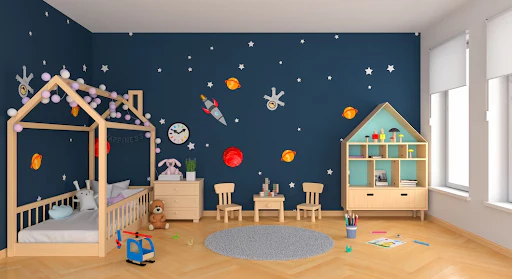

Creating a child’s room is one of the most enjoyable and considerate tasks a parent can undertake. In addition to being a place to sleep, a child’s room should serve as a haven, classroom, play area, reading nook, and creative studio. The appropriate décor may stimulate creativity, promote independence, and showcase your child’s individuality, regardless of whether you’re decorating for a toddler, school-age child, or preteen.
This comprehensive resource looks at kid room décor ideas that combine style, safety, functionality, and inventiveness. These suggestions will assist you in creating a room that develops with your child and brings happiness every day, regardless of whether you’re starting from fresh or remodelling an existing area.
The Significance of Kid Room Décor
Children flourish in settings that are both stimulating and reassuring. A well-designed space can:
Encourage education and research
Promote accountability and organisation.
Offer relaxation and emotional stability.
Reflect and reaffirm their identity and interests.
Making a space that is uniquely yours fosters your child’s sense of pride and ownership while also demonstrating your value for them.
Step 1: Take the Child’s Needs and Age into Account
Every developmental stage has its own requirements and preferences.
1. Young children (ages 1–3)
Put an emphasis on places that are calm, accessible, and safe.
Incorporate soothing hues, low furnishings, and soft textures.
Add interactive features such as wall-mounted sensory boards or tactile toys.
2. Young children (ages 3–5)
Playing imaginatively is essential.
Utilise décor with an animal, fairy, or space theme to encourage play and storytelling.
Open shelf and low storage containers promote self-sufficiency.
3. Children at School (Ages 6–9)
Create a study space to promote learning.
Allow their interests, favourite characters, or favourite colours to reflect who they are.
Make the organisation more structured.
4. Preteens (10–12 years old)
Give people more freedom to choose their own designs.
Combine elements of sophisticated and whimsical décor.
Put your comfort, privacy, and personal space first.
Colour Schemes for Children’s Rooms
Colour affects creativity, focus, and emotion. Consider your child’s tastes and temperament while selecting colours.
Soft neutrals (beige, sage green, and warm grey) are popular colour schemes. calming and adaptable.
Lavender, mint, and peach pastels are perfect for younger children and peaceful settings.
Brights (yellow, orange, and teal): Fun and vivacious.
Accents in monochrome: Simple, contemporary, with accessories adding splashes of colour.
To give your child a sense of pride, let them assist in selecting the colour scheme.
Ideas for Kids’ Room Wall Décor
The walls serve as a blank canvas for both purpose and expression.
1. Decals & Wall Murals
Apply decals like maps, trees, animals, or stars on your wall.
Consider custom-painted scenes such as towns, forests, or underwater worlds, or mural wallpaper.
One wall can be painted with chalkboard paint for messages and drawings.
2. Interactive and instructive walls with posters of letters or numbers
Maps of the world and murals of geography
Letters, artwork, or educational games on magnetic walls
3. Art walls and display boards
For their crafts, use wire displays or cork boards.
Changing gallery walls to display crafts and drawings
Frames or clipboards to replace homework
Furniture Ideas: Fun Meets Function Safe, useful, and versatile furniture is ideal for kids.
1. Styles of Beds
Toddler beds: Side railings and low to the ground.
Loft beds are ideal for tiny spaces since the area underneath them may be used for a workstation or a play area.
Bunk beds are perfect for sleepovers or shared rooms.
Convertible beds: Long-lasting cribs that can be used as toddler and twin beds.
2. Solutions for Storage
Toys are stored in cube shelves with cloth bins.
drawers beneath the bed for linen, shoes, or clothing.
Toy chests with lids that softly close.
built-in lockers or wardrobes to create a schoollike atmosphere.
3. Spaces for Study and Play
ergonomic seats and desks that are suitable for a person’s height.
fold-out workstations that are mounted on the wall for tiny areas.
Use canopies, teepees, or tents as peaceful spots or play areas.
Ideas for Lighting in Children’s Rooms
Sleep, study, and reading habits are all aided by adequate lighting.
1. Lighting in general
Dimmable ceiling lights make it easier to change the lighting throughout the day.
Whimsy is added with LED lights in the shapes of balloons, stars, or clouds.
2. Task Lighting For schoolwork, use desk lamps with movable arms.
Clip-on lights for loft areas or bunk beds.
3. Galaxy projectors or soft-glow lights in the shape of animals for the evening.
Nightlights that turn on as you move to the restroom.
Ideas for Themed Kid Room Décor
Exciting and engrossing are themed rooms. Give your child the freedom to select a favourite theme and work from there.
1. Jungle Adventure Themes: Safari toys, green wallpaper, and animal designs.
Ocean: wave murals, fish or mermaid artwork, and blue colour schemes.
Space: Moonlamps, rocket beds, and glow-in-the-dark stars.
2. Fantasy and Creativity Themes Princess/Fairy Tale: delicate pastels, canopy beds, and castle wallpaper.
Superhero: shield-shaped wall hooks, comic book murals, and bedding with a superhero theme.
The artist’s studio features paint-splattered carpeting, colourful décor, and easels.
3. Themes of Education
Planet posters, robotics, and arithmetic games are all part of the STEM lab.
Book-themed decor, beanbags, and book nooks may be found in the library loft.
For simple upgrades as interests shift, themes can be combined with detachable décor such as rugs, beds, and decals.
Concepts for Common Children’s Rooms
Giving up personal space or style is not necessary while sharing a room.
1. Zones of Use
Use colour schemes, rugs, or drapes to create divisions.
Assign distinct shelves and storage.
2. Kids may have fun and save space with bunk or loft beds.
Use tent-like canopies or built-in curtains to create privacy.
3. Personalised but unified
Maintain the coherence of the basic colour scheme.
Permit each youngster to adorn their side with unique artwork or themes.
Ideas for Storage and Arrangement
For parents in particular, tidy rooms are cheerful spaces!
1. Toy Storage Is Open
To make cleanup easier, use bins with labels or graphics.
Toys should be rotated frequently to maintain freshness.
2. Organisation of the Closet
To improve accessibility, install lower rods.
For accessories, use hanging racks or baskets.
3. Ingenious Storage Solutions
Drawers integrated inside the window chairs.
To showcase toys, bookcases were flipped on their sides.
rolling carts for doll accessories, Legos, or art tools.
Ideas for Low-Cost Kid Room Décor
Creating a wonderful setting doesn’t require a large budget.
1. Do It Yourself Projects
Make your own accent wall or mural.
Repurpose furniture by giving it new knobs and paint.
Make your own gallery of artwork or photographs.
2. Thrifting and Upcycling
Refurbish outdated dressers, desks, or bookcases.
Purchase used bedding, décor, and frames.
3. Make Use of What You Have Repurpose ottomans, cushions, and storage baskets.
Let your kids help choose and decorate.
Ideas for Rotating and Seasonal Décor
Kids and their interests change quickly. Make the space lively and flexible.
1. Seasonal Information
Make use of seasonal hues for curtains, blankets, and cushions.
Use banners or lights with a Christmas theme to decorate.
2. Revolving Screens
Change out the books on a shelf for presentation.
Every few months, swap out the wall decals or artwork.
3. Wall of Growth Charts
Fun and useful, particularly when fashioned into a ruler, rocket, or tree.
Tips for Longevity in Design
Children grow up fast. Make design decisions that change as they do.
First, pick neutral bases.
Large furniture pieces and neutral walls make it simple to update with accessories.
2. Select Convertible Furniture To save money and effort, choose desks, seats, and beds that can be adjusted over time.
3. Give Them the Lead
Let your child choose the accessories, colours, or themes. They feel more in control and are more creative as a result.
Safety Considerations for Children’s Rooms
Good design should always start with safety.
Secure bulky pieces of furniture to the wall.
Tie cords out of reach or use window coverings without cords.
Electrical outlets should be covered.
Steer clear of furniture with sharp edges.
Make use of low-VOC, non-toxic paints and coatings.
In conclusion, a space for growth
Creating a child’s room is a fulfilling way to encourage their development, imagination, and self-assurance. Building a space where kids feel safe, inspired, and uniquely themselves is more important than aesthetics.
The finest kid rooms change with the child, whether you go big with a themed painting or little with amusing bedding and cosy lighting. You can create a setting that supports their future self and celebrates who they are with a little forethought and a lot of creativity.