Overview
Living in an apartment frequently means having restricted space, especially in cities. But style and functionality don’t have to be sacrificed for small living. Even the smallest apartment can be made into a lovely, cosy, and incredibly functional home with the correct flat design ideas.
Creative design techniques may optimise space, enhance flow, and create a personal haven that represents your taste, regardless of whether you’re moving into a studio, one-bedroom apartment, or a multi-bedroom flat. This book covers everything you need to create a flat that feels roomy, welcoming, and distinctively yours, from smart layouts and creative storage options to lighting, colour schemes, and décor selections.
Recognising the Difficulties and Possibilities in Flat Design
By their very nature, apartments have some restrictions:
Space Restrictions: Every inch of available space must be used effectively.
Layout Restrictions: Usually preset floor layouts that don’t allow for many structural adjustments.
Storage Requirements: In the absence of integrated storage options, clever substitutes are required.
Lighting: Natural light may be scarce in apartments located in crowded urban areas.
Privacy: It might be difficult to establish distinct areas, particularly in studio apartments.
Nonetheless, these limitations present innovative chances to experiment with functionality and design. Flats can be transformed into aesthetically beautiful, well-organized, and optically larger residences with the help of ingenious design techniques.
Important Guidelines for Apartment Design
1. Make the Most of Space with Clever Layouts
Whenever feasible, choose open floor plans. A feeling of space is produced by combining the kitchen, dining, and living spaces. To conserve space, use multipurpose furniture like foldable tables, sofa beds, or storage ottomans.
2. Establish Functionality Zones
Comfort can be improved even in a studio by physically or visually separating spaces for working, sleeping, eating, and unwinding. To establish separate areas, use furniture placement, shelving, curtains, or carpets.
3. Make Use of Vertical Space
In addition to offering plenty of storage, tall cabinets, wall-mounted shelves, and hanging organisers free up floor space.
4. Select Reflective Surfaces and Light Colours
Light-colored floors, furnishings, and walls all contribute to the room’s ability to reflect natural light. Glass components and mirrors can improve the sense of space.
5. Use Sufficient Lighting
To add ambience and light to shadowed areas, use ambient, task, and accent lighting in layers. Flexibility is increased with movable fittings.
Popular Designs for Flats
1. Ideas for Studio Flat Designs
Murphy beds are foldable mattresses that fit into cupboards or walls to free up room during the day.
Loft beds are raised beds that have workstations or seats underneath.
Sliding partitions are movable partitions that split living and sleeping spaces.
Compact Kitchens: Space-efficient linear or L-shaped kitchen units.
Vertical shelves, under-bed drawers, and hidden compartments are examples of smart storage.
2. Design Ideas for One-Bedroom Flats
Open Plan Living and Dining: Combining these spaces and using a bar counter or island as a discrete partition.
Built-in Wardrobes: For optimal storage, closets extend from floor to ceiling.
Multipurpose furniture includes sleeper sofas and extending dining tables.
Area rugs and artwork are examples of decorative elements that can be used to delineate areas without walls.
Integrate the balcony into the living room by using the outdoor area as an extension.
3. Larger and two-bedroom apartments
Distinct Work Zones: Specific spaces for home offices or studies.
Room zoning is the process of defining areas by using variations in colour and texture.
Gallery Walls: Using artwork and framed photographs to add individuality.
Statement Lighting: To create drama, use pendant lights or chandeliers.
Smart Kitchen Design: To keep things tidy, modular units and built-in appliances are used.
Creative Storage Options
In order to maintain clutter-free rooms, storage is essential in flat design:
Drawers or boxes for clothing, linens, or shoes are examples of under-bed storage.
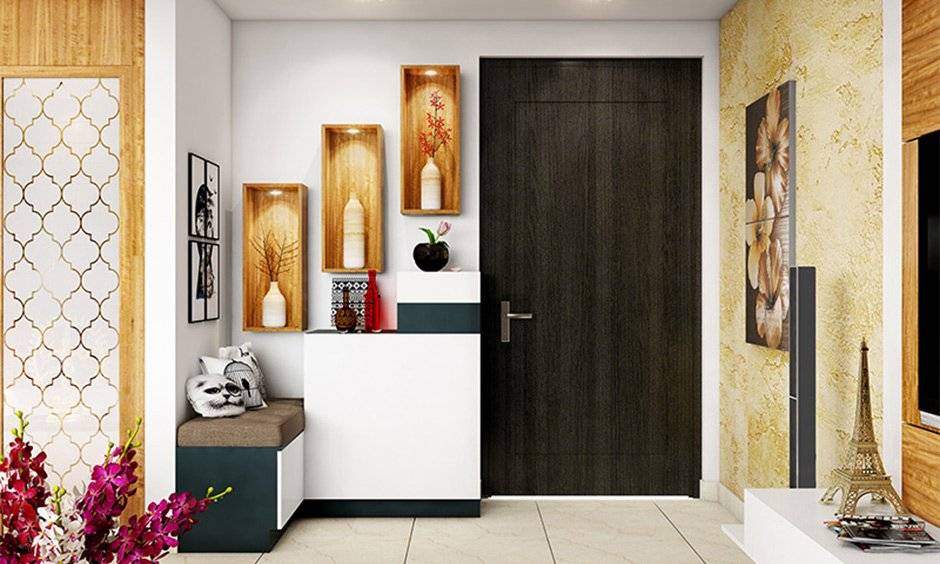
Wall-mounted shelves that don’t occupy any floor space are called floating shelves.
Benches and storage ottomans are multifunctional pieces of furniture that serve as both seating and storage.
Over-door organisers: For cleaning materials, shoes, or accessories.
Built-in Cabinets: Designed to maximise utilisation around corners or appliances.
Neutral Base Colour Schemes and Materials: Whites, beiges, and greys give the impression of space and openness.
Accent Colours: To enhance cosiness and individuality, choose pastels, jewel tones, or earthy shades.
Natural Materials: Stone, rattan, and wood provide warmth and texture.
Metallic Accents: For contemporary touches, choose chrome or brass finishes.
Soft Textiles: Curtains, carpets, and cushions provide comfort and softness to the room.
Lighting Techniques for Apartments
By improving functioning and establishing ambience, lighting can completely change an apartment:
Layered Lighting: Put together table lamps, floor lamps, and ceiling lights.
Task Lighting: Workspaces, reading nooks, and the kitchen should have focused lighting.
Accent lighting draws attention to architectural details or works of art.
Smart lighting: Adaptable colour temperature and brightness to suit various moods.
Enhancement of Natural Light: To enhance daylight, use mirrors and light curtains.
Advice for Choosing Furniture
In apartments, selecting the appropriate furniture is crucial:
Size Is Important: Choose slender profiles over large furnishings.
Foldable desks, nesting tables, and sofa beds are examples of multipurpose items.
Lightweight and Mobile: Flexible layouts are made possible by furniture that is portable or on wheels.
Custom Pieces: Furniture that is made to fit odd corners or places.
Simple shapes and clean lines avoid visual clutter in minimalist designs.
Decoration & Customisation
Use tasteful décor to make your apartment seem like home:
Plants: Indoor plants bring life and enhance the quality of the air.
Artwork: Character prints, paintings, or personal photographs.
Textiles: To stay warm, stack throws, cushions, and rugs.
Mirrors: Improve impression of space and light.
Books and Collections: Arrange important objects in a tidy manner.
Integration of Technology
Smart technology makes modern apartments more convenient:
Voice-activated lights, thermostats, and security systems are examples of smart home appliances.
Compact refrigerators, microwaves, and washers are examples of space-saving appliances.
Hidden wiring: cables that are hidden for a neat appearance.
Device-specific locations are known as charging stations.
Ideas for Eco-Friendly Apartment Designs
The importance of sustainable design is growing:
Lighting that uses less energy: LED bulbs use less energy.
Eco-friendly materials include furniture made from repurposed wood and bamboo flooring.
Water-saving fixtures include dual-flush toilets and low-flow faucets.
Natural air purifiers can be found in indoor plants.
Waste management: recycling facilities and compost bins.
Case Studies: Chic Apartment Designs Case 1: Light wood floors and white walls in a minimalist studio apartment.
A Murphy bed concealed behind a bookcase.
Open shelves in a tiny kitchen.
multifunctional table for work and dining.
curtains from floor to ceiling to diffuse light.
Case 2: Modern One-Bedroom Flat with Accents of Mustard and Blue on a Neutral Base.
Living in an open concept with a little kitchen island.
Storage built into one wall.
over-dining pendant lighting that makes a statement.
The balcony serves as a tiny garden alcove.
Case 3: Two-bedroom apartment with a family-friendly zoning, area rugs, and a variety of wall colours.
a dedicated study area featuring a desk that can be folded up.
Lots of closed storage space for supplies and toys.
furniture with washable and long-lasting textiles.
Bedrooms with blackout curtains and soft lighting.
Typical Errors in Flat Design to Avoid
excessive furniture and congestion.
disregarding the necessity for storage.
inadequate lighting design.
Selecting dark hues for cramped areas.
failing to establish effective zones.
In conclusion
It takes careful planning to maximise space, enhance functionality, and create a home that feels roomy, cosy, and true to your style. Apartment design is more than just choosing furniture and colours.
Apartments may be turned from small and disorganised into sophisticated and welcoming havens where every square inch matters with the correct design concepts. Using clever layouts, imaginative storage, and tiered lighting will make your apartment a pleasure to live in, regardless of your preference for modern flair, minimalist design, or cosy eclecticism.